Clarity Is Not Discovered. It Is Assembled.
There are moments in healthcare when the challenge is not a lack of knowledge, but a lack of connection.
Modern medicine has achieved remarkable depth. Every specialty brings years of expertise, precision, and an in-depth understanding of a specific part of the human body. This level of specialization has transformed patient care and saved countless lives.
Yet, the human body rarely follows neat boundaries.
Many medical conditions do not present themselves as a single, obvious problem. Instead, they reveal themselves gradually through a collection of seemingly unrelated symptoms. Each symptom may appear ordinary on its own, but together they tell a very different story.
The real challenge is often not knowing more, it is seeing how the pieces fit together.
Beyond Specialization: Seeing the Whole Picture
The traditional journey of diagnosis is often straightforward. A patient develops symptoms, consults a specialist, undergoes investigations, and receives treatment.
For many conditions, this approach works exceptionally well.
However, some disorders refuse to stay within the boundaries of a single specialty. Symptoms may involve the brain, heart, lungs, metabolism, or sleep simultaneously. Patients often move from one consultation to another, with each expert addressing an individual piece of the puzzle.
What becomes essential in these situations is not another isolated opinion, but integration—the ability to step back and understand how every finding relates to the others.
This is where artificial intelligence is beginning to play a meaningful supporting role.
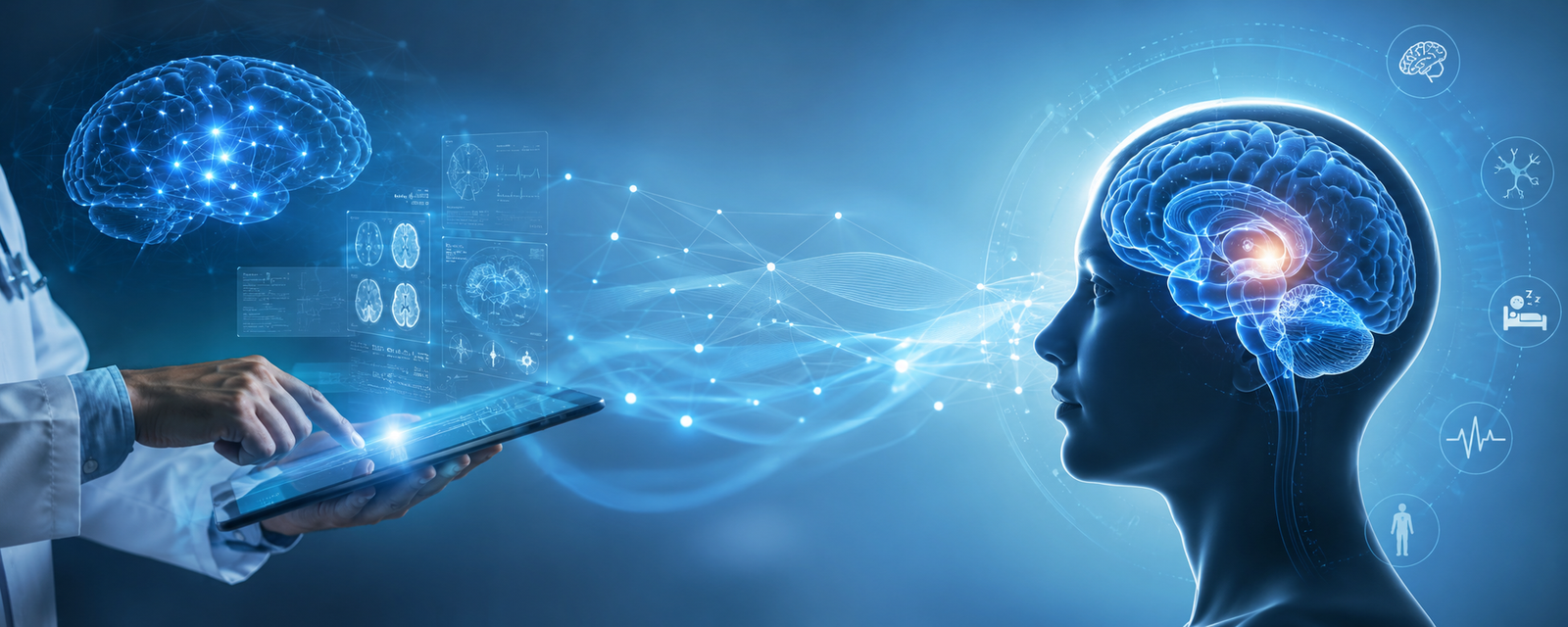
Unlike a medical specialist trained to focus on one system, AI can analyse large volumes of clinical information simultaneously. It can compare symptoms, medical histories, imaging findings, laboratory results, and patterns observed across thousands of similar cases, helping clinicians identify relationships that might otherwise remain unnoticed.
It is not offering a different story. It is helping reveal the complete one.
When Patterns Matter More Than Individual Symptoms
Neurology often reminds us that the most important clues are not always the most obvious ones.
Take Sleep Apnea, for example.
Many people associate it simply with loud snoring. In reality, its effects extend far beyond disrupted sleep. Persistent morning headaches, daytime fatigue, memory difficulties, poor concentration, mood changes, high blood pressure, and even an increased risk of stroke can all be connected to an underlying sleep disorder.
Seen individually, these symptoms may lead patients to different specialists. Treated separately, the larger picture can remain hidden for years.
When clinical information is viewed collectively rather than in isolation, these connections become far easier to recognise.
This is where AI demonstrates its greatest strength, not by making decisions, but by identifying patterns. It can highlight combinations of symptoms and clinical findings that deserve closer attention, prompting clinicians to ask the right questions sooner.
Sometimes, a single connection can change the direction of an entire diagnosis.
Supporting Clinical Judgment, Not Replacing It
Artificial intelligence is often misunderstood as a replacement for medical expertise.
It is not.
AI cannot examine a patient, understand personal experiences, appreciate emotions, or exercise clinical judgment in uncertain situations. These remain uniquely human responsibilities.
What AI can do is assist clinicians by processing information quickly, recognising complex patterns, and reducing the possibility that important details are overlooked.
Technology strengthens the process.
The diagnosis, the decision-making, and the care remain firmly in the hands of experienced healthcare professionals.
In that partnership, technology becomes an extension of human intelligence rather than a substitute for it.
A New Way of Understanding Complexity
Healthcare is becoming increasingly data-rich. Every consultation, investigation, scan, and laboratory report adds another layer of information.
The challenge is no longer finding more data.
The challenge is making sense of it.
Artificial intelligence offers a powerful way to connect information that may otherwise remain scattered across different reports, specialties, and timelines. When combined with the knowledge, experience, and intuition of clinicians, it creates a more complete understanding of the patient's health.
That shift has the potential to improve not only diagnosis but also earlier intervention, more personalised treatment, and better long-term outcomes.
The Future Is Collaboration
The future of healthcare is not about choosing between human intelligence and artificial intelligence.
It is about combining the strengths of both.
Clinical expertise brings judgment, empathy, ethics, and experience. Artificial intelligence contributes speed, scale, and the ability to recognise patterns across vast amounts of information.
Together, they create something more powerful than either could achieve alone.
Because sometimes the answer is not hidden.
It is simply waiting for every piece of the puzzle to come together.